

OLEDs are being used more and more frequently in smartphone screens and televisions. They are also a very promising alternative for lighting purposes, for example flat panels where the colour of the light can be varied.
The main components of OLEDs are emitter molecules that are intermixed in organic semiconductors. These emitters “harvest” energy from the recombination of electron-hole pairs in the semiconductors and transform this energy into light. Two different pair states (singlets and triplets) can occur in the process. Good emitters are able to transform both types into light. At present, compounds of iridium, a rare and expensive metal, are used for this purpose.
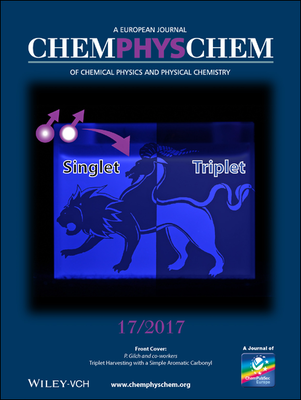
Together with colleagues from Durham University in the UK headed by Professor Andrew Monkman, the Femtosecond Spectroscopy Working Group led by Professor Peter Gilch at the Department of Physical Chemistry of Heinrich Heine University Düsseldorf set out to identify simple organic molecules as alternatives to today’s emitters – and they found some very promising candidates. Their discovery is so important that the scientific journal CHEMPHYSCHEM dedicated a cover story to it.
Professor Gilch and his colleagues identified simple aromatic carbonyls as emitters. These are also able to “harvest” the two types of electron-hole pairs without the need for a metal ion. A carbonyl’s basic structure comprises a carbon atom that is bonded to an oxygen atom via a double bond. This basic structure is also found in many natural products.