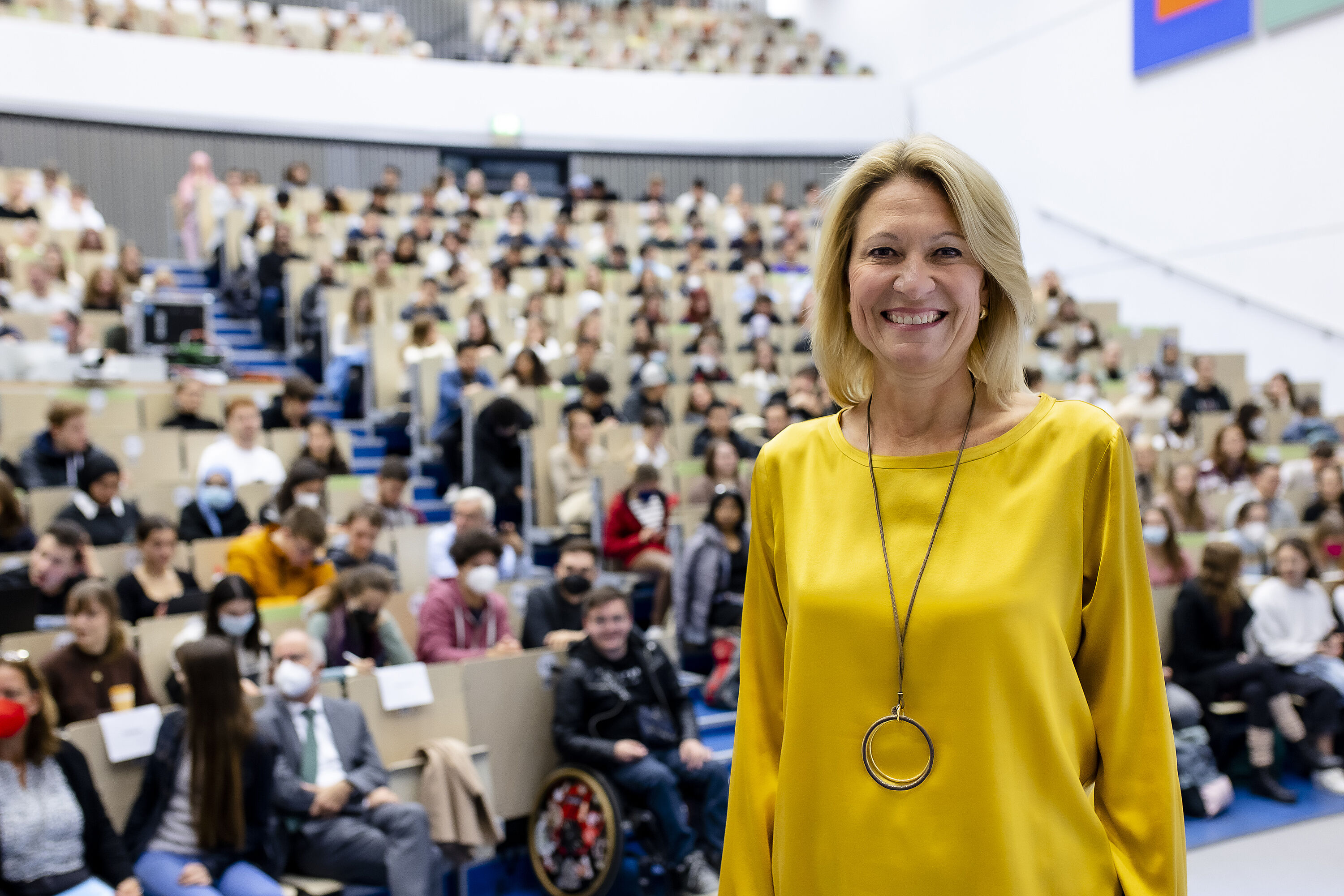
All the seats in lecture theatre 3A were occupied when the President stepped onto the podium to welcome the new first-year students to HHU. “We wish you all the best for this new and extremely exciting part of your lives here with us in Düsseldorf. You will meet many interesting people, learn to master new challenges and hopefully also be able to enjoy life as a student.”
Professor Steinbeck emphasised that HHU will do everything in its power to ensure that students’ studies run as smoothly as possible, while being a great experience: “We are living in times of crisis, which are placing extraordinary burdens on us all. Nevertheless, the university management will do everything it can to ensure teaching can continue on campus. And we are currently very confident that we will succeed in this.” The President concluded her address by quoting Heinrich Heine: “Every age has its problem, by solving which humanity is helped forward.”
The Vice President for Quality in Studies and Teaching, Professor Dr Christoph Börner, encouraged the first-year students to keep an open mind and look beyond the boundaries of their own subjects: “In the next few years you will get to know many interesting topics and influential people. Take the opportunity to look beyond the various aspects of your own subject – getting a taste of other subjects is enriching and opens up new perspectives. And make the most of your time on campus – during your studies you will meet people who will be important throughout your life, while the years you spend here could be one of the best periods of your life.”
Celine Coldewe, Chair of the General Student’s Committee (Allgemeiner Studierendenausschuss – AStA), welcomed the new students on behalf of the student body: “The AStA represents students. We engage in dialogue with a wide variety of people and organisations to ensure that student needs are heard.” The AStA provides advice and support on all issues relevant to students. Coldewe encouraged everyone to play an active role – also in university politics: “Get involved and make a contribution to creating conditions for students as you would like to see them.”
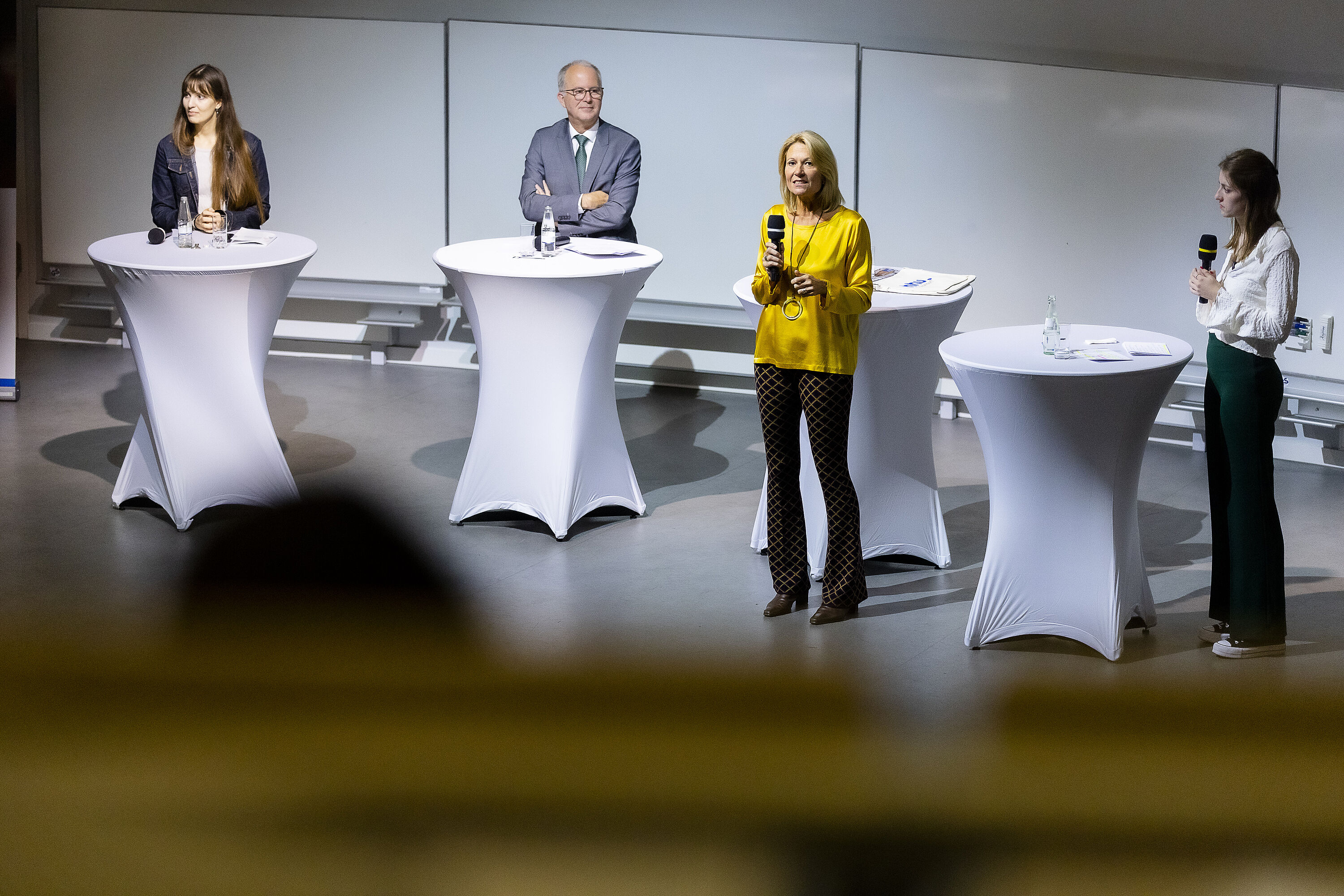
In a session moderated by Greta Stangner from Düsseldorf university radio, the President, Vice President and AStA Chair answered questions submitted by students before the event. These included topics such as the extent to which the coronavirus and the energy crisis could impact the current semester. The university management emphasized that the aim is to ensure studies take place on campus as far as possible, although this will mean that certain offers need to be limited to ensure that the University can meet its obligation to save energy in the coming winter. The President stated that students will not even notice many of these measures. HHU will however be limiting the off-peak opening hours of the libraries as only a few students use the facilities at these times. In this context, it was emphasised that everyone at HHU must take responsibility and do their bit to ensure that the semester is a success.
After the in part serious messages, comedian David Werker brought the event to an entertaining close with extracts from his programme “Suddenly serious?!” Werker, who frequently appears on radio, TV and the stage, began his career as a perpetual student, publishing a tongue-in-cheek guide to student life. Now 36, he is taking a humorous look at life after university. His appeal: “Don’t lose touch with the child inside your head.”
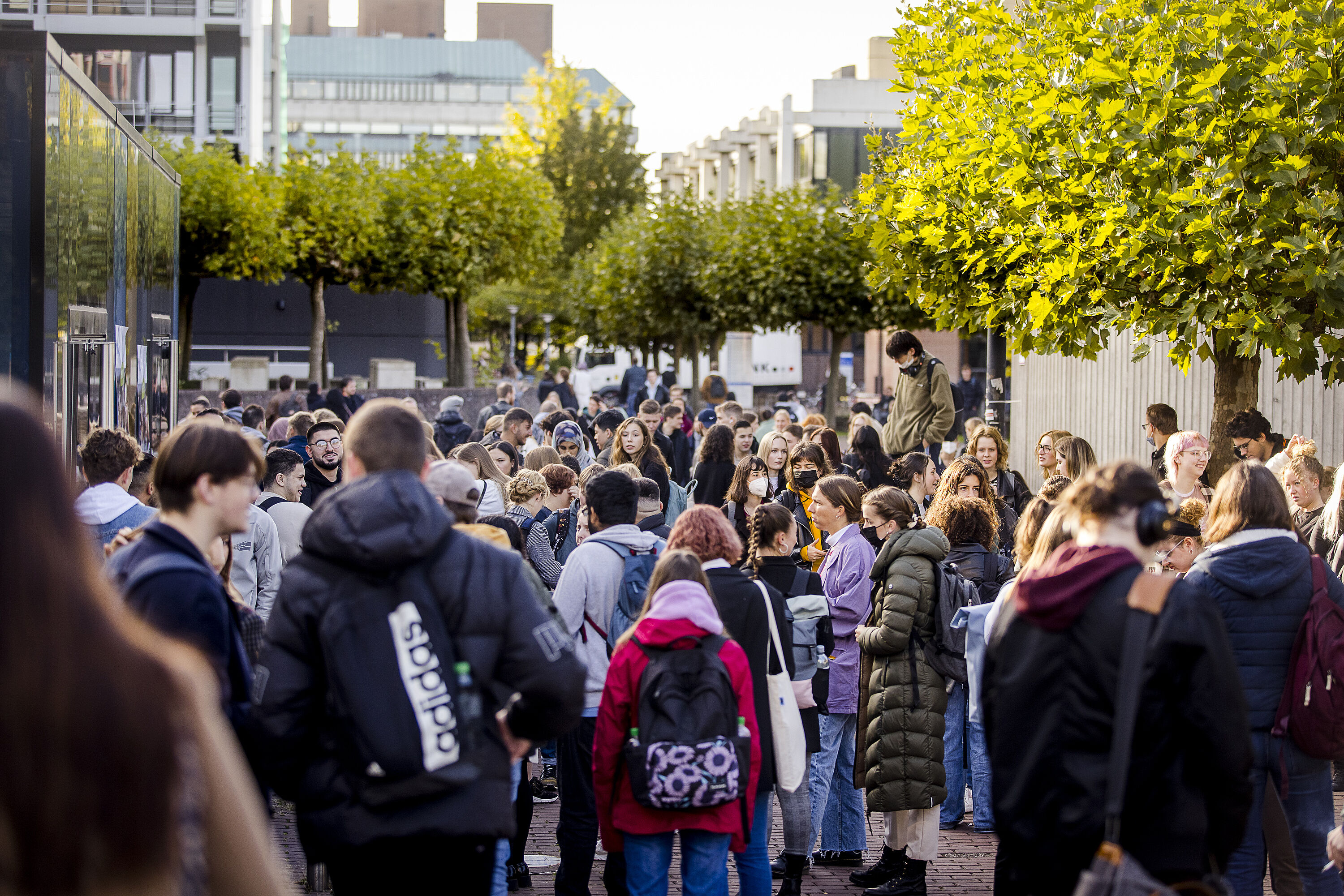
In the foyers outside the lecture theatre, numerous HHU institutes and facilities introduced themselves to students at an information bazaar: Where can students obtain support during their studies, how can they access grants and how can they get involved? The HHU offering was supplemented by stands run by the university radio station, as well as sport, cultural, social and religious organisations and foundations in Düsseldorf.
Preliminary figures at the start of the winter semester 2022/2023 (reference date: 4 October 2022):
At the reference date, Heinrich Heine University Düsseldorf (HHU) had a total of 32,540 students; at the reference date in the prior year, this figure was 32,683. Around 12% of these students are international students (up slightly from 11% the year before).
A total of 3,754 new students (students in their first semester at university) had enrolled at the University by 4 October 2022, which is a slight increase on the previous winter semester (2021: 3,644 students at the same reference date). The percentage of new students has increased slightly from 11% to 12% year-on-year, while 15% of the students now starting a degree at HHU are from abroad.
At the reference date, the five most popular study programmes were the Computer Science bachelor’s degree programme, followed by the Biology bachelor’s programme, the State Examination for Medicine, the State Examination for Law and the Business Administration bachelor’s programme. The top 5 study programmes in the previous year (in ranking order) were Business Administration, Medicine, Biology, Law and Computer Science.
In percentage terms, the Industrial Pharmacy, Molecular Biomedicine, Financial and Actuarial Mathematics, Natural Sciences and Transcultural Humanities study programmes have enjoyed the greatest growth over the past five years.
Alongside those students studying for bachelor’s degrees and State Examinations, 723 master’s students are also starting their studies in the winter semester. Almost half of these students (330) are enrolled at the Faculty of Mathematics and Natural Sciences, followed by the Faculty of Business Administration and Economics (216), the Faculty of Arts and Humanities (120) and the Faculty of Medicine (57).
With 14,847 students in total, the Faculty of Mathematics and Natural Sciences is the largest faculty at HHU, accounting for almost half (46%) of all regular students currently enrolled. The Faculty of Arts and Humanities is next with 26% (8,540 students), then the Faculty of Medicine with 13% (4,169 students), the Faculty of Business Administration and Economics with 9% (2,802 students) and the smallest faculty – the Faculty of Law – with 7% (2,182 students). The Faculty of Mathematics and Natural Sciences and the Faculty of Arts and Humanities have decreased somewhat in size overall compared with the preceding years, while the other three faculties have grown slightly.
Currently, students can still apply for places in the bachelor’s study programmes Natural Sciences, Quantitative Biology, Social Sciences and Business Chemistry, the bachelor’s major in Art History and minor in Japanese Studies, and the State Examination programmes for Law and Dentistry via the local clearing procedure.
Please note: All these figures refer to regular students including cross-registered students (headcount and excluding waiting-list candidates). The figures relating to first-year students and their breakdown by faculty and subject are provisional statistics only (trend) at the reference date of 4 October 2022. These figures change daily as clearing procedures are not yet complete. Final statistics are expected in December 2022.