

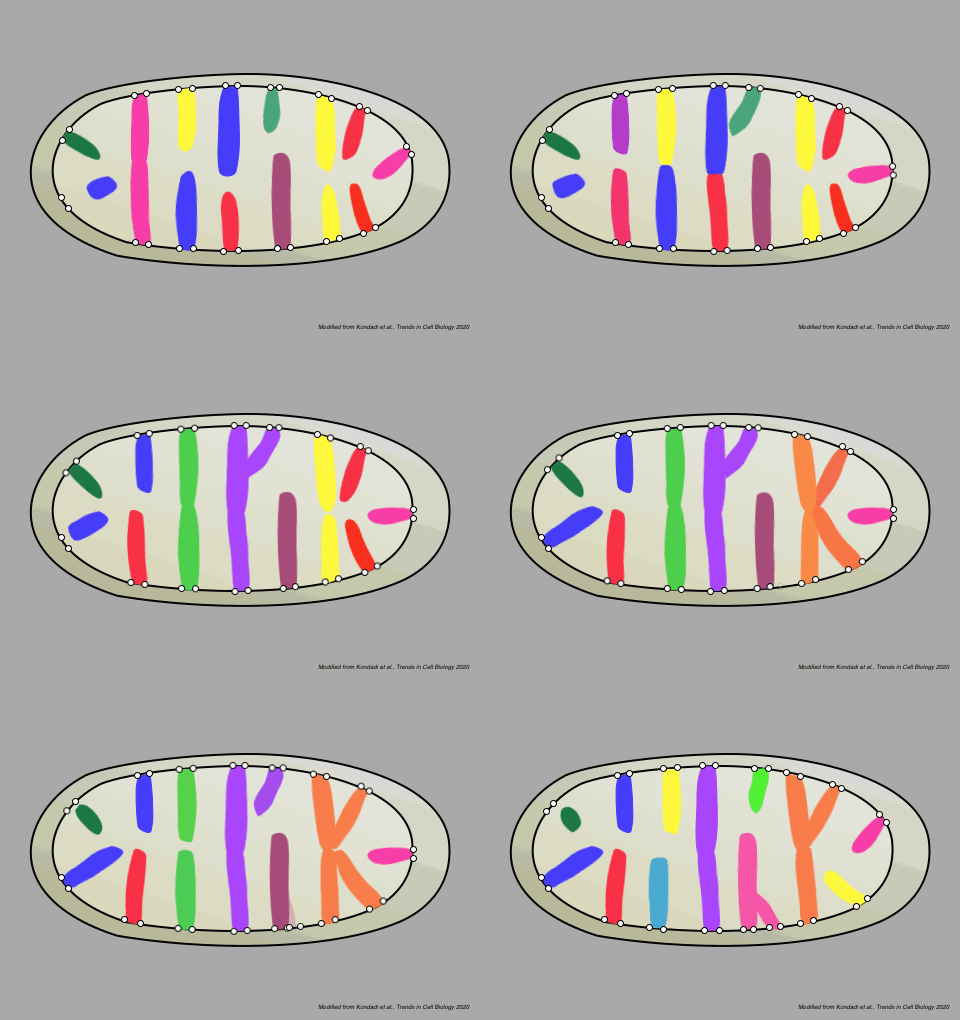
Mitochondria are little, yet essential, batteries and power houses of living cells. For the last 60 years, these organelles and its complex membrane architectures were considered as very static albeit they exhibit an immense structural diversity in different cells or tissues. This static view prevailed as mitochondrial ultrastructure was classically determined using a static method, electron microscopy, revealing an outer membrane and an inner membrane harbouring numerous invaginations.
The latter are termed cristae membranes which accommodate large protein complexes converting electrical energy into chemical energy in the form of Adenosinetriphosphate (ATP). Cristae were recently shown to act as individual mini-batteries. Another big surprise came with state-of-the-art possibilities of using newly developed super-resolution techniques allowing researchers to image mitochondrial membranes in living cells for the first time. Several groups have revealed that cristae are highly dynamic at a timescale of seconds. There is cumulating evidence that this possibly even involves inner membrane fission and fusion events.
In a comprehensive review, Dr. Arun Kondadi, Dr. Ruchika Anand, and Prof. Andreas Reichert from the ‘Institute of Biochemistry and Molecular Biology I’, Medical faculty, Heinrich Heine University (HHU) Düsseldorf provide an overview on the major findings, obtained by extensive research from many groups including their own group in Düsseldorf, Germany. It describes critical advances which led to this paradigm change on our view on mitochondria after more than 60 years. We also discuss that this is likely to have fundamental physiological implications in health and disease, what are the advantages of cristae dynamicity, and what are the exciting research questions which will drive the field in the coming years such as how cristae membrane dynamics contributes to diabetes and Parkinson’s disease. This topic is also covered at the HHU as part of the Collaborative Research Center 1208 "Identity and dynamics of membrane systems - from molecules to cellular functions" (speaker Prof. Lutz Schmitt).
Original publication Kondadi et al. 2020 in Trends in Cell Biology