

The hot, dry summer this year has raised awareness in Germany too of the tremendous challenges faced by farmers and agriculture as a result of climate change: cereals, vegetables and forage crops withered in the fields and meadows, harvest yields in 2018 will be far lower than in previous years. Such a summer will not remain the exception, but instead become the rule in coming years.
Not only German and European agriculture are confronted with major problems as a result - the whole world is. Global warming not only makes it increasingly difficult to irrigate crop plants. Agriculture is also threatened by more and more frequent extreme weather events, which not only endanger harvests but also damage usable cropland through erosion and salinisation.
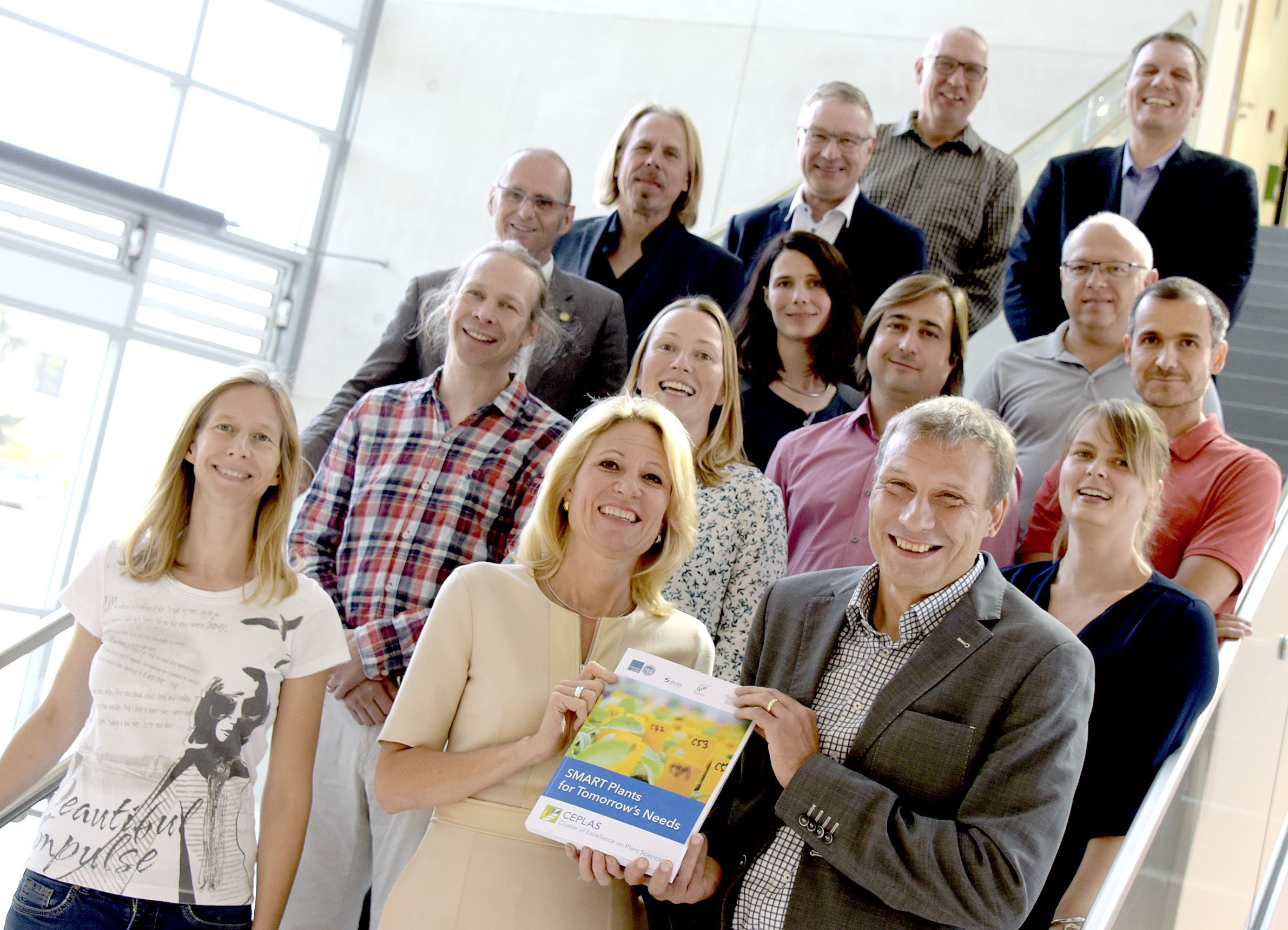
Crucial to securing food supplies for the world’s population in view of these circumstances is the development of new types of plants that are not only far higher yielding than today’s varieties but also less sensitive to drought, soil erosion and extreme weather. This is what the CEPLAS Cluster of Excellence will be exploring.
Spokesperson for the cluster is Professor Andreas Weber from HHU’s Institute of Plant Biochemistry; co-spokesperson is Professor Stanislav Kopriva from the University of Cologne. “CEPLAS is the only cluster in the framework of the Excellence Strategy that concentrates exclusively on the genetic basis of plant traits,” highlights Professor Weber. “This means that researchers in Düsseldorf, Cologne and Jülich are working on one of the most important global tasks of the future.”
The researchers in Düsseldorf, Jülich and Cologne are focussing on cereal types that today represent a major part of food supply: barley and rice. However, their research work also touches on a whole range of other crops, such as wheat, maize, rape and Brassica varieties.
“We’re very happy that Heinrich Heine University will continue to receive funding in the framework of the Excellence Strategy and as a result be able to further develop its research activities in the field of plant sciences,” stressed HHU President Professor Anja Steinbeck. “Alongside the funding from the German Research Foundation, the University is putting in place a sustainable infrastructure for this research work in the shape of two new research buildings: the ‘Centre for Synthetic Life Sciences’ will be up and running before the end of 2018 and the ‘Plant Environmental Adaptation Centre’ (PEAC) will follow in a couple of years.”
An important aspect of CEPLAS is its PR work in the area of plant sciences and green genetic engineering. “Our aim is to explain to citizens the objectives, possibilities and risks of our work and in so doing so create trust in science,” says Professor Weber. For example, CEPLAS established the lecture series “An der Wurzel gepackt” (“tackle the root”) to inform a public audience about current topics in the area of plant sciences. The format aims to deliver the most important background, facts and arguments to enable people to form their own opinion about a specific topic.
(Link: www.ceplas.eu/en/discover/public-events/an-der-wurzel-gepackt/)
CEPLAS research programme
The CEPLAS researchers intend to analyse the interaction of complex plant traits, which influence crop yield and how the plants adapt to limited resources and changing environmental conditions. In this context, they want to examine in depth the genetic basis of plant traits and how they are influenced by environmental factors. This will make it possible to predict for the first time which of the plant’s genetic traits (and the associated microbes) allow the best performance under specific environmental conditions.
For example, the researchers want to understand how certain leaf shapes evolve, e.g. simple or complex, narrow or broad. Leaf shape influences the rate of photosynthesis as well as how a plant adapts to rising temperatures and CO2 concentrations.
In addition to research, CEPLAS runs an extensive programme in support of early career researchers that already starts at Bachelor level. The next step is a graduate school that provides intensive supervision for doctoral researchers. These activities lead into a programme for postdoctoral researchers and junior research group leaders, which supports young scientists in the next stages of their research careers.
Excellence Strategy of Germany’s federal and state governments
In contrast to the preceding “Excellence Initiative”, in which HHU was already successful with the CEPLAS Cluster of Excellence, the “Excellence Strategy” offers a longer term perspective. A total annual budget of € 533 million is earmarked from 2018 onwards. New calls for tenders for the funding lines are announced at regular intervals.
In total, 88 full proposals were submitted for Clusters of Excellence. A panel of experts composed primarily of scientists working abroad was responsible for evaluating these proposals on behalf of the German Research Foundation and the German Council of Science and Humanities. It was announced on 27 September 2018 that 57 of these projects will be funded. The Clusters of Excellence can start work from 1 January 2019 onwards.